While elite sports properties showcase innovation on the pitch, a significant operational gap persists behind the scenes. N3XT Sports CEO, Mounir Zok, argues that many organisations are currently “flying blind,” deploying tactical AI tools on top of fragmented legacy systems rather than building a strategic data architecture.
In this interview — the first in The Pundit’s Seat, a new WFS content series featuring in-depth conversations with experts across different areas of the football industry — Zok introduces AI Pulse, a diagnostic tool developed by N3XT Sports that maps individual and organisational AI readiness to help sports properties move from AI adoption to AI maturity, and provides key industry benchmarks to break down the “perception gap” between leadership goals and technical reality. He explains what truly separates the organisations that merely experiment with AI from those that have the structural maturity to actually compete through it.
Does the impact of AI compare to other major technological transformations in history, or are we dealing with something qualitatively different — and does sport, as a historically slow adopter, reflect that or defy it?
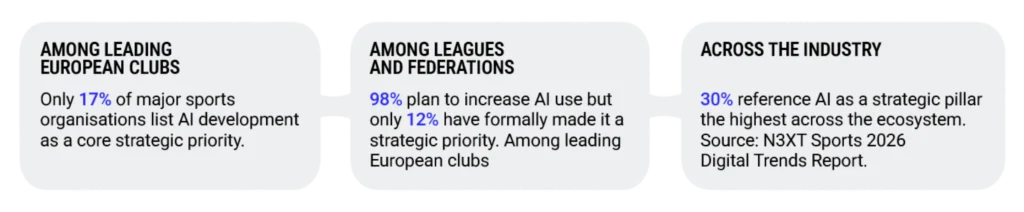
We are dealing with something qualitatively different, because AI is arriving at the exact moment sport is shifting from instinct‑driven to data‑native decision‑making. N3XT Sports research shows that while around 80% percent of major sports organisations prioritise sustainability, governance and commercial growth, only 39 percent formally integrate data governance and just research shows that while around 17% percent list AI development as a strategic priority, so AI is exposing structural weaknesses in how data is treated, not just adding another tool on top. Sport therefore reflects its history as a slow adopter where it matters most – in digital infrastructure, data governance and skills – even as a small group of properties (particularly elite clubs) are starting to defy that pattern by elevating data and AI to the boardroom.
You’ve spent years working with sports organisations on digital transformation. When AI entered the conversation, what changed — and what’s actually happening inside the industry today, beyond the noise and the conference demos?
The biggest change was urgency: digital transformation stopped being framed as “modernisation” and started being framed as competitiveness. Our research shows that while around 2026 Digital Trends Report shows that across Olympic/Paralympic IFs, elite European clubs and major event organisers, organisations are heavily focused on ESG, fan engagement and commercial growth, but far less mature on the digital and data foundations that AI depends on, which makes AI an immediate strategic issue rather than a distant innovation topic. Beyond the conference demos, the reality is that most organisations are using AI tactically – to support content production, reporting and basic analytics – while a smaller, more advanced group is beginning to integrate predictive analytics into governance, performance and commercial decisionmaking in a more systematic way.
Where is AI delivering real, measurable impact inside a sports organisation today — on-field performance, operations, commercial, fan engagement? And where are the biggest opportunities that no one is effectively capturing yet?
We already see measurable impact in four domains: performance (for example, clubs like Real Madrid using AI‑driven predictive injury modelling to support player health and tactical decisions), operations (automation of registrations, approvals and reporting in projects such as Saudi Arabia’s National Sports Platform ), commercial (more granular sponsorship reporting and inventory packaging enabled by centralised data models), and fan engagement (as with FIVB, where coordinated, data‑driven content strategies contributed to over Saudi Arabia’s National Sports Platform ). However, N3XT Sports research also shows that only 36% percent of major sports entities treat digital transformation and data governance as strategic pillars, which means the biggest untapped opportunity is still to connect these pockets of AI use to a unified stakeholder database and governance framework, so that AI becomes the “binding agent” of an integrated revenue and performance engine rather than a collection of isolated use cases.
Sport has long used technology as a showcase — VAR, player performance tracking, athlete instrumentation. But how much does what happens on the pitch or on the broadcast actually reflect what’s going on inside these organisations? Is there a gap between visible innovation and real operational transformation?
There is a clear and measurable gap. Across 18 of the world’s leading competition organisers (including the Premier League, LaLiga, UEFA, FIFA and the IOC), our analysis shows that 83% percent emphasise sustainability, 72% percent fan engagement and 67% percent governance, but only 33% percent highlight digital transformation and 33% percent data governance, with just 11 percent naming AI as imperative to success. That means the product fans see – VAR, tracking, augmented broadcasts – often sits on top of fragmented systems and siloed data internally.
Some sports have always been more open to technological innovation than others — Formula 1 being the obvious example. Is that same stratification playing out with AI? And where does football sit in that map — given its global scale, what’s at stake if it moves slowly?
Yes, the stratification is already visible in the data. Among 20 leading European football clubs , 95% percent emphasise governance and integrity, 75% percent commercial expansion, 70% percent fan engagement and 90% percent ESG, while structured data governance climbs to 40% percent and around 30% percent explicitly reference AI as a strategic pillar – a higher operational maturity than we see in most federations and major events. At the same time, the wider ecosystem still treats AI as peripheral, with only 17% percent of entities across sectors naming AI development as a core strategic focus, so if football as a whole moves too slowly in normalising AI‑enabled, data‑native models, it risks building ambitious ESG and commercial agendas on fragile digital foundations and losing ground to more data‑mature sports and to tech platforms that already own the fan relationship.
Your white paper draws a distinction between organisations that use AI and those that are genuinely AI-native. What concretely separates them — is it a technology gap, a culture gap, a leadership gap?
The gap is all three, but it starts with leadership and culture and then shows up in technology. AI‑using organisations treat AI as a feature – a project or tool that sits on top of existing ways of working – whereas AI‑native organisations design their strategy, operating model and data architecture assuming that AI will be part of decisionmaking everywhere.
You also identify a perception gap between senior leadership and operational teams. Why does that gap exist — and what are the consequences for organisations that don’t close it, commercially and eventually on the pitch?
The perception gap exists because leaders and operators are living different versions of AI adoption. On one side, our work and the 2026 Digital Trends Report show that roughly four in five sports organisations already adopt AI solutions and 98 percent plan to increase use, but only 12% percent of major leagues and federations actually position AI as a formal strategic priority, and around one in five adopters say in‑house skills are their biggest barrier – so executives hear “we’re using AI everywhere” while operational teams feel under‑resourced, under‑trained and constrained by legacy systems.
Where have you seen organisations invest seriously in AI and come away with less than they expected — and what went wrong? Is there a pattern to the failures?
The pattern is consistent: AI is deployed on top of weak or fragmented data foundations. Our cross‑sector analysis shows that while 62% percent of entities prioritise commercial expansion and 62% percent fan engagement, only 53 percent invest meaningfully in digital transformation and 39 percent in data governance , so AI is often asked to solve problems that are actually structural – siloed systems, inconsistent data, unclear ownership. As a result, many AI projects become isolated pilots inside single departments, with no centralised data core, no federated governance model and no leadership‑driven AI mandate, which means early results cannot be scaled, and AI gets wrongly labelled as “interesting but not transformative” rather than “misaligned with our foundations”.
What were you seeing with clients that wasn’t being solved — and what led you to build AI Pulse as a response to that specific problem? What does an organisation learn about itself going through it that it didn’t know before?
We kept meeting organisations that were ambitious about AI, had already made investments, but were effectively flying blind about their true readiness across strategy, technology, data, governance and people. N3XT Sports research shows the same structural misalignments at industry level – ESG without data architecture, commercial ambition without integrated fan intelligence, AI adoption without executive oversight – and we were seeing those play out inside individual clients with no shared framework to diagnose them. AI Pulse is our response: a structured, organisation‑wide assessment anchored in the Universal Data Pyramid and our cross‑sector benchmarks that gives leadership and operational teams a single, evidence‑based picture of where their real bottlenecks are, how misaligned their perceptions might be, and what a realistic 12–36 month roadmap towards becoming genuinely AI‑native looks like.
We’ve talked about what AI can do for sport — but what can it do to it? What are the risks that the industry isn’t taking seriously enough yet?
The first risk is strategic dependency: if organisations outsource too much of their AI capability without owning their data architecture and governance, they risk surrendering control over the “connective tissue” that links sustainability, fan engagement, operational efficiency and commercial growth. The second is that, as our research shows, many entities are scaling tactical AI use while lagging badly in education and governance – only about a third list digital education and change management as a priority – which creates exposure around ESG reporting, , cyber risk , and integrity if AI amplifies weak data or poor processes at scale.
Five years from now, how will AI have changed the experience of the fan — whether they’re playing the game, sitting in the stands, or watching at home? What shifts fundamentally?
Five years from now, AI will blur the line between elite and everyday experiences: the kind of data universe LaLiga already operates in – with roughly 3.5 million data points generated per match and fed into performance, production and commercial decisions – will start to reach grassroots and amateur participants through consumer‑grade tools. In stadiums and at home, the fundamental shift will be from one broadcast and one matchday journey for millions to millions of dynamically tailored journeys,