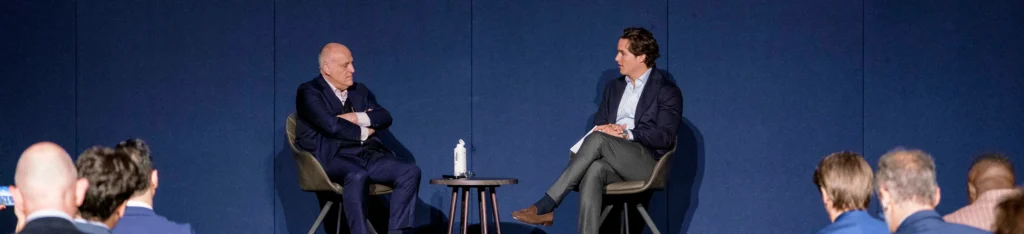
“Football is the infrastructure for community, identity, and belonging” – that is how Kike Levy frames the asset he has spent his career building around.
Levy is CEO of Gameday by NJF, the sports and media investment platform of NJF Holdings, founded by entrepreneur and investor Nicole Junkermann. Before that, he spent nearly 17 years at Twitter and Meta, helping sports organisations navigate the shift to digital — building media partnerships, developing content strategies and unlocking new monetisation models at a time when the industry was still figuring out what social media meant for football.
In the second episode of The Pundit’s Seat, Levy draws on that experience to argue that football is navigating its own structural turning point: one where the real challenge is no longer how much fans pay for content, but how easily they can access it.
He also discusses the investment thesis behind Gameday, whose sport portfolio includes Lega Volley Femminile (Italy), and CayoTV (Spain), and what clubs and leagues are still leaving on the table.
You spent nearly 17 years at the heart of the attention economy at Twitter and Meta. How did that experience shape your perspective on football as a sport, as a business and as an entertainment product?
Sports has always been my life’s great passion, and for many years I had the opportunity to see the sports industry from the eyes of the Big Tech Companies. Sport, and football in particular, competes with every notification vibrating in a fan’s pocket. Today we live in the attention economy, and in this economy, sport (and again, football in particular) are in a unique position because nothing brings people together like sport does.
As a business, my experience showed me that data isn’t just a “vanity metric”, it’s the language of fan loyalty. As an entertainment product, I realized the 90-minute match is merely the “anchor”; the true value today lies in the infinite conversation, the “at-the-moment” content, and the ability to fragment the experience to fit the lives of a “global, mobile-first audience”.
Nicole Junkermann recently argued that investors often misunderstand global sport by treating it as a cyclical media asset rather than long-term infrastructure. How does this ‘infrastructure mindset’ practically change the way Gameday evaluates a football property compared to traditional asset management?
Football, in general, is an industry mainly driven by a very short-term vision. Traditional asset management looks at football through the narrow window of 3-to-5-year TV rights cycles.
At Gameday, guided by Nicole’s vision, we view it as social and digital infrastructure. A bridge or a road is valuable because of what flows across it; football is the infrastructure for community, identity, and consumption. This shift means we don’t just look for a quick “exit multiple.” We evaluate a property based on its ecosystem’s robustness, its ability to own its data, its direct-to-consumer (D2C) potential, and its resilience against market volatility. We invest in systems, not just seasons.
The “Napster moment” and the future of the industry
You’ve described sport as living through its own “Napster moment.” In the music world, that moment forced a complete pivot in how value was captured. Is football currently losing control of its distribution, or is it just failing to price it correctly for the digital age?
I often draw a parallel between music and sports because both are foundational to human identity. In the early 2000s, music hit its “Napster moment” —the internet didn’t just change the format; it shifted the power dynamic. After a painful transition, the industry emerged stronger, moving from a single-source revenue model to a diversified ecosystem of streaming, live experiences, and digital assets.
Sport is currently navigating that same inflection point. The legacy model, which leaned almost exclusively on the analog scarcity of massive media rights deals, is under immense stress. We are moving from an era where the fan hunts for content to an era where the content needs to find the fan. The barrier today isn’t price, it’s friction. Our mission at Gameday is to eliminate that friction, ensuring that the emotional bond of football isn’t lost in a fragmented digital landscape, but rather made more accessible through smarter, user-centric business models.
If the solution for sport’s “Napster moment” doesn’t come from the traditional rightsholders, what kind of actor is going to provide it, and how will that intervention redefine the industry’s revenue models and long-term business sustainability?
The solution will come from tech-integrators with an investment soul. These are actors who don’t just buy rights, but build the “operating system” of the sport. This intervention will redefine revenue models from “wholesale” rights dumping to a platform economy. We will see models driven by sponsorship, micro-transactions, gamified experiences, and mass personalization. The sustainability of the business will depend on moving from a one-size-fits-all broadcast model to a deep, data-driven relationship with each individual fan.
Technology, valuation, and lost opportunities
Beyond distribution and how we watch the game, in which specific areas is technology having the most direct and measurable impact on its market valuation?
Without a doubt, fan data is the ultimate value-unlock. In the legacy model, clubs rented their audience from broadcasters and social platforms; in the Gameday model, they own it. By replacing ‘gut feeling’ with measurable intelligence, a property transforms from a speculative asset into a predictable business. When you use AI to understand exactly who your fans are and how they transact, that shift from guesswork to data-certainty is what fundamentally re-rates a club’s business.
What specific revenue streams or operational efficiencies is the industry currently “leaving on the table” because it hasn’t yet integrated technology at a deeper level?
The biggest missed opportunity in football today is the lack of hyper–personalization. We live in an era where every other aspect of our digital life is tailored to us, but football still clings to a one-size-fits-all model. I don’t believe there is a single, hidden revenue stream left on the table – I think we are leaving growth on the table across every existing stream. Whether it’s ticketing, sponsorship, or merchandise, data acts as the ultimate multiplier. By replacing generic outreach with precision, we don’t just increase revenue, we increase operational efficiency and, ultimately, the enterprise value of the property.
There is a debate over whether technology democratizes the industry or simply helps Tier 1 properties pull further away. Does Gameday see technology as an equalizer or as a tool for further market consolidation?
At Gameday, we see it as a potential equalizer, but only for the agile. While Tier 1 properties have the capital, mid-tier properties have the speed to pivot. Technology allows a modest club to build a profitable, niche global community that can rival a giant’s margins. Sports properties need to start seeing themselves as a digital-first brand.
The investment thesis
After years at the heart of Big Tech, you moved into investment. What is the specific investment thesis at Gameday that justifies building a dedicated sports and media vertical in this current economic cycle?
Nothing brings people together like sport does. In an on-demand world, sport remains the last frontier of the ‘Live Experience’ making it fundamentally unique. In an era of infinite distraction, live sport is the only asset that guarantees mass attention in real-time—and attention is the new hard currency. Perhaps most importantly, as AI transforms every other sector, sport remains disruption-proof. You can’t automate the grit of a comeback or the raw emotion of a last-minute goal; that unscripted human achievement is our greatest asset. At Gameday, we invest at the intersection of content, data, and technology to make that human magic scalable and recession-proof.
Football is an emotional industry, but capital requires rigor. What does the experience of Gameday and Nicole Junkermann in other tech sectors bring to football that the industry is currently lacking in its decision-making?
Precision over passion. Football is perhaps the most emotional industry on earth, but at Gameday, we believe that emotion should be the fuel, not the GPS. What Nicole Junkermann and our team bring from sectors like biotech, fintech, and deep tech is a culture of extreme rigor. In high-stakes tech sectors, you don’t make multi-million dollar bets based on a gut feeling or the result of a single Sunday; you make them based on predictive modeling, data sovereignty, and long-term infrastructure health.
Specifically, we bring a data-driven approach that replaces speculation with measurable intelligence, applying the same level of due diligence found in life sciences to the football ecosystem. This is supported by ecosystem thinking, where we refuse to see football as just a game, viewing it instead as a tech-enabled platform where every touchpoint is interconnected. Finally, we implement operational discipline by bringing a relentless focus to unit economics and digital efficiency, ensuring the business is as high-performing as the athletes themselves.
By applying the Human Code, we ensure that while our decisions are powered by the cold logic of technology, they are always aimed at protecting the very thing that makes football valuable: the raw, human connection between the club and the fan.
There is a growing debate on the need to balance expansion with the nurturing of football’s emotional bond. At WFS, we believe this bond is the industry’s primary asset. Nicole recently wrote that the true value of sport lies in its ‘scarcity’—the fact that a moment cannot be infinitely replicated without losing its meaning. How do you scale a football business globally without over-commercializing it to the point where you destroy both that scarcity and the emotional bond?
The key is to scale the access, not the product. As Nicole rightly points out, the scarcity of the 90-minute match, the unscripted drama that only happens once, is the industry’s most sacred asset. If you try to replicate the match itself infinitely, you dilute its value. However, you can scale the emotional connection to that moment by using technology to remove the barriers between the club and its global community.
At Gameday, we believe that over-commercialization happens when you treat fans as a generic mass to be exploited. We avoid this by using data to provide intimacy at scale. Nothing can substitute the experience of a fan going to the stadium, but technology today allows a fan in Jakarta to feel the same connection to the club as a season-ticket holder in London, not because we’ve sold them a generic product, but because we’ve given them a personalized window into the club’s soul.
Scaling without destruction requires a Human Code approach: using technology as a bridge, not a barrier. By protecting the scarcity of the live event while hyper-personalizing the digital experience, we can grow the business globally while actually deepening the emotional bond. We aren’t just expanding a brand; we are inviting more people to participate in a shared, irreplaceable history.
The WFS Leadership Club
Gameday and World Football Summit have partnered to launch the WFS Leadership Club, an international circuit of private dinners designed to connect senior executives and investors for candid, off-the-record dialogue. What is the core value of building this specific ecosystem, and what does it offer that the traditional industry circuit does not?
The core value of the WFS Leadership Club is radical honesty. Traditional industry events are often performative, but this group provides a private environment to talk about the game behind the game. It is an ecosystem designed for high-level problem-solving away from the noise of the headlines.
What sets this apart is the move from networking to deep connection. We enable senior executives to discuss structural challenges and cross-industry innovations with total candor. We believe the most significant transformations in football won’t happen on a stage, but across a dinner table. This is the Human Code in action, building the trust and personal bonds necessary to drive the long-term sustainability of the sport.