
One week before the World Cup kicked off at Estadio Azteca, over 1,700 football industry professionals from more than 40 countries gathered at Camino Real Polanco for the third edition of World Football Summit Mexico City. Over two days and more than 40 panels, 137 speakers from clubs, federations, investment funds, broadcasters and technology companies debated the future of the game in the Americas and beyond. These are ten conclusions we took away from those conversations.
1. Mexican football has 84 million reasons to stop talking about potential.
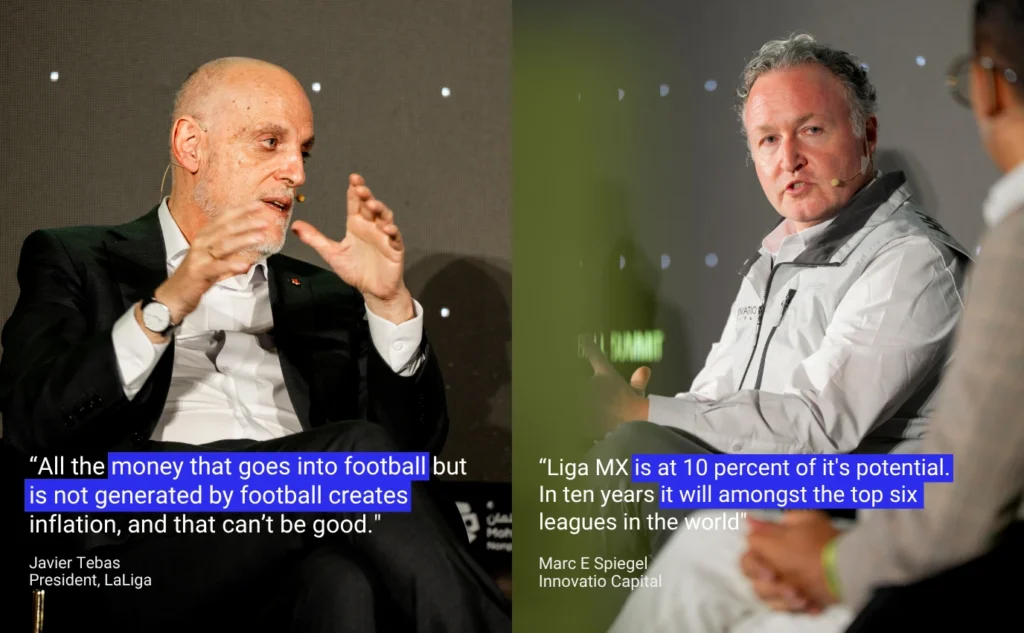
The World The World Cup is the most visible expression of a moment that was already in motion long before the tournament arrived. The Clausura 2026 final drew more than 84 million viewers across Mexico and the United States. The Liga MX Femenil final outperformed the Women’s Champions League in television audiences. The football economy in Mexico is worth 52 billion pesos — five times the cinema industry. Marc Spiegel, the American owner of Querétaro FC and one of the first foreign investors in Liga MX history, described where the league stands commercially: “From a content perspective, we’re at about 10%. We’re in the second inning of a nine-inning game.” Kike Levy of NJF went further: “In four years, Liga MX will be a top six league in the world.”
2. The match is the starting point, not the destination.
The ninety minutes remain the emotional core of everything the industry builds around. But they are no longer the product. Kelly Shouldice, VP of Brand and Content at the Northern Super League, was direct: “The full match is the foundation — but it’s not the main product anymore. The younger generations are not watching ninety minutes. They want the stories around it.” Sascha Fussmann of One Life Agency pointed to where the value is migrating: “People want to follow people. Whoever manages to really sell the perspective of a player and owns the full content storyline — that’s gonna be the winner.”
3. Women’s football is offering brands something men’s football has priced them out of.
The Liga MX Femenil final drew more viewers than the Women’s Champions League final. Claudia Carrión of Club América framed the ambition: “We want women’s football to be not just a moment, but a movement.” The brands arriving in the women’s game are finding something the men’s game, after decades of commercial saturation, can no longer offer: space. Space to build relationships, to reach audiences that haven’t been claimed, to activate in ways that aren’t possible when every inch of a shirt and every second of broadcast time already has a price. Stefano Petruzzo, CEO of Marseille’s women’s side, described treating a match at the Vélodrome as an all-day event: “In women’s football we have the chance, given that the opportunity cost is lower, to think differently — instead of just reaching for a betting partner because they pay the most.”
4. The next generation of fans isn’t an audience to be reached. It’s a community to be built with.
The generation that will define football’s commercial future grew up in an entertainment landscape built around participation, creation and instant gratification. Gaming finals already outperform the World Cup and the Super Bowl in audience — and football is competing for the same attention. Alejandro Lesende of Concacaf built Concacaf Kickoff entirely with teenagers, not for them: “We didn’t bring in agencies that know years of marketing.” Juan Diego García of GGTech Entertainment put the structural challenge plainly: this generation does not experience entertainment passively. On TikTok alone, five million pieces of sports content are published every day — created, shared and consumed by the same audience football is trying to reach. The clubs and federations making progress with younger audiences share one approach: they stopped designing for them and started designing with them.
5. Fan data is only as good as what you do with it.
“If you have a million fans and only ten percent transact with you, that million is nothing more than a vanity metric,” said Joshua Flores of Tradable Bits. Club América has spent years building a data infrastructure that has changed the conversations it has with commercial partners entirely. Brands no longer come asking about follower counts. They want to know what fans consume, when they come to the stadium, what their lives look like outside it. Jorge Balandra put the ambition simply: know each fan by name, and make that knowledge work in their favour. The returns on that kind of direct relationship can be striking. Grêmio sent a message to a thousand fans who hadn’t attended in six months. Thirty-five percent came to the next match. No promotion, no discount. Just an invitation.
6. A stadium used eighteen times a year is a business problem.
“The major revenue has to come from what this stadium is for ten minutes after the game ends,” said José Ramón Fernández of Grupo Pachuca. Chris DeVolder of Gensler put the arithmetic plainly: there are 168 hours in a week and a stadium is used for three of them. The model points toward venues integrated into the daily life of their cities — retail, hospitality, residential, content studios — generating value every day of the year. As Alejandro Barca of L35 Architects put it: “There is nothing more unsustainable than a building that isn’t used.”
7. AI is already working in football. Just not where most clubs are looking for it.
LaLiga reduced piracy consumption by 60% through dynamic blocking and saw broadcast rights values grow 10% as a direct result — €130 million in additional revenue. Daniel Benchimol, of DAZN, whose platform nearly tripled NFL subscribers after taking over the rights: “If you’re not working on AI right now, start. Because you’re gonna fall behind.” Javier Tebas framed it as an operational imperative: “Any organisation that doesn’t implement AI is going to become ineffective and uncompetitive.” The clubs that have embedded it in fan data, referee evaluation and performance analysis are not running a pilot. They are running a different operation.
8. Fairer decisions are becoming a commercial asset.
Mexico became the first country in the Americas to implement Semi-Automated Offside Technology, and the results from the Clausura 2026 are concrete: 25% faster offside decisions and VAR reviews down from over a minute to 39 seconds. “A VAR review that used to take a minute ten seconds, we now have in 39 seconds. That is transformation,” said José Luis Chávez of the FMF. But beyond officiating, something less expected is happening. The decision visual has become sponsorship inventory. Leagues are selling advertising space within it. Harry Lennard, of Genius Sports, put the wider implication plainly: the system does not just produce fairer decisions. It produces a content asset that broadcasters, fans and sponsors are finding genuinely valuable. “Transparency and trust go hand in hand. That’s how this technology builds its case.”
9. FIFA has more member countries than the United Nations. In 70% of them, women are still not welcome on a football pitch.
Eglantina Zingg, Founder of Goleadoras, put the scale of the unfinished work in a single sentence. Mary Connor of Common Goal added the urgency: “We are 186 years away from achieving gender equality on this planet. Women’s football has an incredible opportunity to accelerate that.” The gains being made are not symbolic. “Gains in women’s football are influencing livelihoods, careers, career pathways, GDP of countries,” said Connor. The Women’s World Cup arriving in Brazil in 2027 is the next moment the industry has to make count.
10. Purpose-driven football is generating returns that traditional sponsorship can’t match.
Mary Connor of Common Goal described a structural shift in how the most effective partnerships are being built: “Brands don’t need to do it how they’ve always done it. Flip it on its head — centre the agreement on philanthropy, with brand assets worked in. There is real ROI in that new way of doing business.” Melissa Pardi, of US Soccer Federation, described a programme bringing football into schools across the United States, built in partnership with Bank of America, with curriculum resources, equipment and measurable legacy built into the commercial structure. The result is access to communities and long-term relationships that visibility-based sponsorship cannot reach.