
WFS Madrid 2026 brought together over 140 senior leaders across more than 40 panels, drawing on executives from governing bodies, top-flight leagues, private equity funds, and properties like Formula 1 or the NFL. Together, they addressed the industry’s key priorities — including governance, institutional capital, stadium infrastructure, player welfare, women’s sport, sponsorship measurement, global market expansion, and AI. Below are ten key learnings for the decade ahead.
1. Governance without industry consultation is becoming football’s biggest structural risk
Three separate disputes ran through WFS Madrid, each one coming down to the same structural gap: decisions get made at the top of the game, and the rest of the industry finds out after the fact. The clearest case was FIFA’s now-abandoned plan to sell a stake in the World Cup’s commercial rights to private investors, known internally as FIFA Forward Enterprise. Professor Laura McAllister, Vice-President of UEFA, was among the first senior figures to call for a full boycott of FIFA competitions if the plan went ahead: “The thought that private equity could be determining decisions about our game filled me with horror — I could hardly imagine how that would transform the game into a monstrous entity that would not serve the fans, the players, the leagues, the clubs.” Rafael Louzán, President of Spain’s RFEF, confirmed his federation’s alignment with UEFA’s position on the FIFA proposal.
Javier Tebas Medrano, President of LALIGA, pointed to a structurally identical grievance on a separate front — the international calendar, expanded and rearranged without consulting the leagues left to absorb the consequences: “This is a governance problem. The men’s national-team World Cup used to end on 13 July; this year it ended on the 19th, without asking us, without agreeing it with us.”
David Aganzo, President of Spain’s players’ union AFE, pointed to the same pattern one level further down the chain: LaLiga’s own attempt to stage a league match in Miami, eventually called off after the team captains organised a collective protest. “LaLiga must understand that the players carry real weight: they’re the ones who travel, they’re the ones who play, they’re the ones who get injured.” Maheta Molango, his counterpart at England’s Professional Footballers’ Association, is fighting the same battle from a different country: he argued that players deserve a seat at the table, and points to the PFA’s own executive education programme as proof it’s a serious claim, not a slogan — training players for sporting director and boardroom roles, with 400 currently enrolled.


2. The definition of a financeable football asset is expanding fast
The private debt market aimed at football has grown from $250 billion in 2014 to $2 trillion today, and 36% of clubs across Europe’s top five leagues are now owned by private equity. Taoufik Bounhar, Global Head of Credit Solutions Trading at JP Morgan, named the assets now entering the conversation: deferred transfer payments monetised in portfolio form, a club’s own proprietary data, and for clubs that have become genuine global brands, the brand’s intellectual property itself. “A number of clubs now are global brands, global fan base, and therefore the intellectual property has a lot of value.” The same capital is reshaping stadiums too.
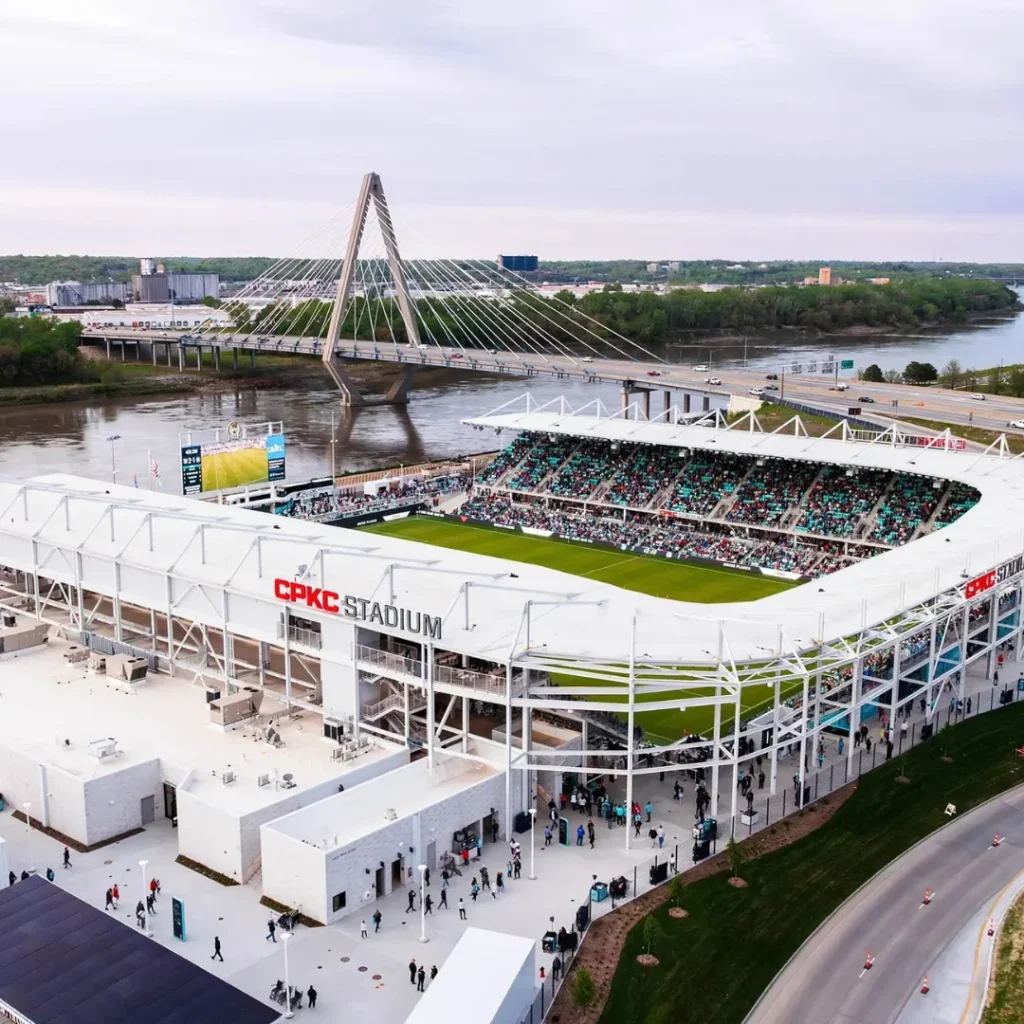
Tim Self, Head of Public Finance & Infrastructure at JP Morgan, described stadiums now anchoring multibillion-dollar mixed-use developments, and pointed to Kansas City’s stadium — the first ever built specifically for a women’s team — as the clearest result of that shift: every suite and season ticket sold out from day one, and the venue is already being expanded from 12,000 to 18,000 seats.
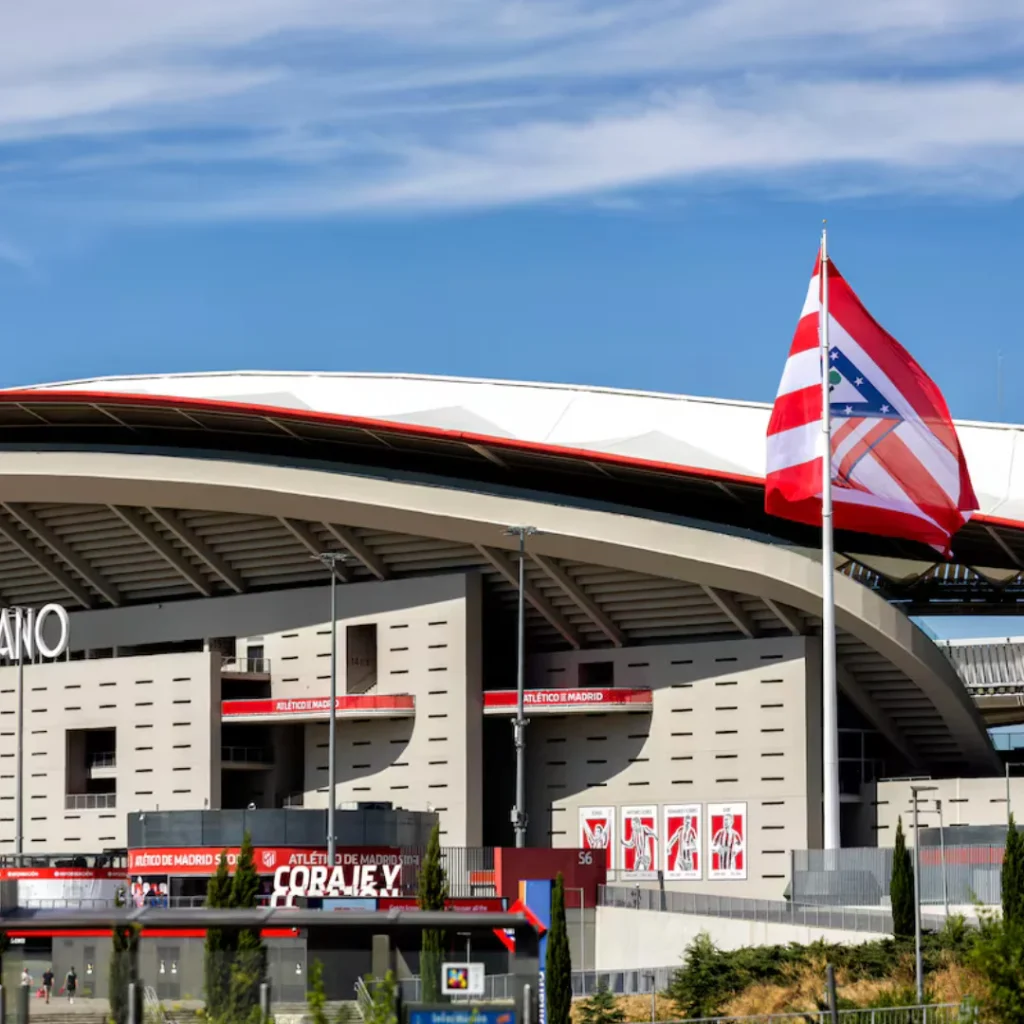
Miguel Ángel Gil Marín, CEO of Atlético de Madrid, gave a European example of exactly that correction already under way: over €500 million in annual revenue without selling a single player, built in large part around a 115-hectare development at the Metropolitano that includes ten different sports facilities, Europe’s largest artificial wave pool, a university campus and a 21,000-capacity concert arena — already generating 260 corporate events, 29 matches and 22 concerts a year.

3. Data and technology advantage is shifting from sophistication to discipline
Football is investing in data and technology across every part of the business — performance, content, the stadium itself — and the same two conditions keep deciding whether that investment pays off: knowing exactly what problem or which fan it’s meant to serve, and knowing who controls the data once it starts moving between partners and providers. Alexander Bodo, CEO of Paceteq GmbH, brought the first condition over from motorsport, which has a twenty-year head start on it: “If the data underneath is crap, the language model will give you a better version of the wrong answer.”
Kike Levy, Head of Gameday at NJF Holdings, made the case that raw fan-engagement numbers only mean something once someone defines what they’re actually meant to measure.
Donna Soane, Director of Global Sponsorship at Orange, made a related point about stadium technology: “Technology progresses, and we tend to get a bit lost in that tech. It becomes shiny. We lose sight of what the fans really want. This is about communities, and they’re not online communities.” Craig Hepburn, CEO & Co-Founder of 1706 Studio, raised the second condition — not what the data is for, but who holds it — advising clubs to stay in control of their own IP and data when working with outside partners.
4. Commercial growth in women’s football is outpacing competitive balance
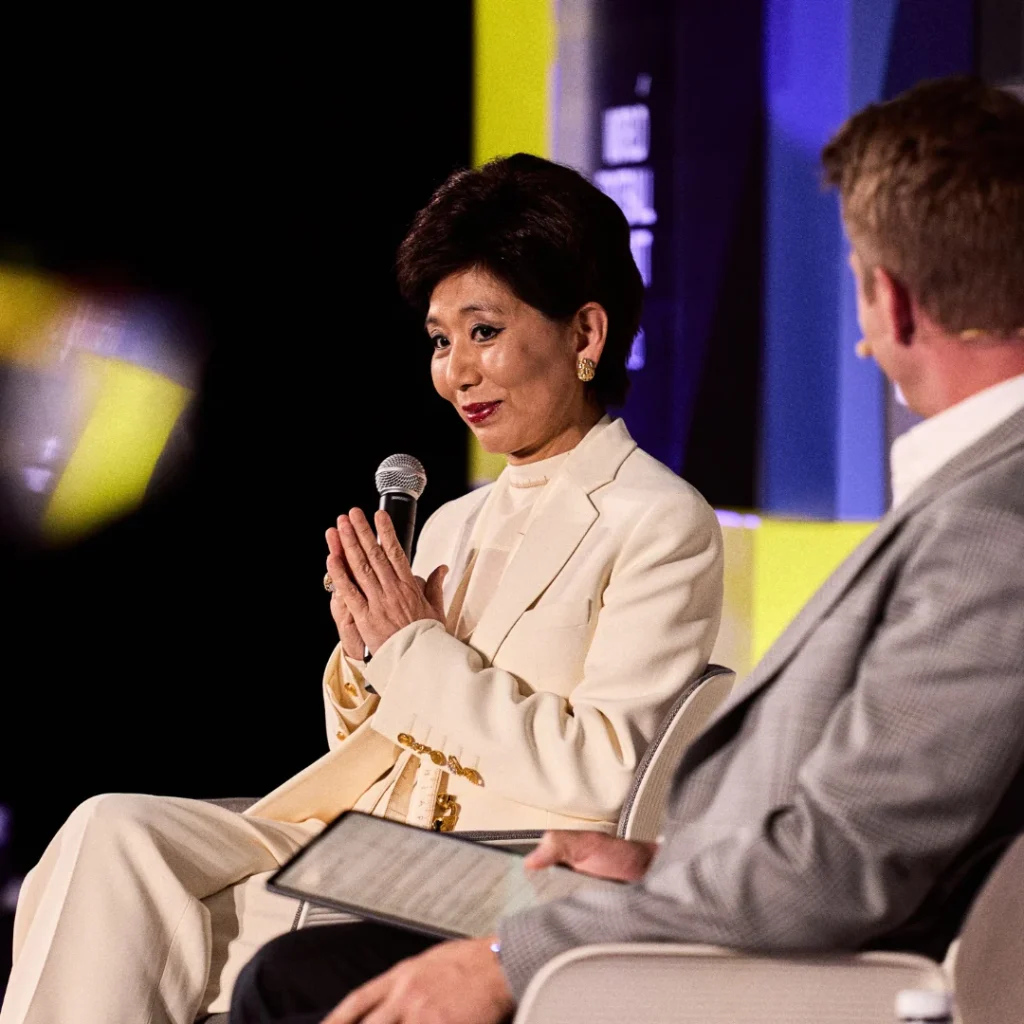
Investment headlines in women’s football have multiplied this year, but growth and competitive fairness aren’t moving at the same speed. Michele Kang, Founder, Chairwoman & President of Kynisca Sports International, and President of Olympique Lyonnais, described the sector as “absolutely a business” with real capital behind it — yet by her own account, a handful of clubs in markets like France, Spain and Germany still dominate disproportionately even as revenue climbs across the board.
Maurits Schön, Managing Director & COO of OneFootball, a digital football media platform, questioned whether the market is even applying the right measuring stick: putting revenue multiples on a European landscape with barely a handful of professional leagues is “rushing things a little bit,” he argued, when men’s football took a hundred years to become a business and was culture and community long before it was one.
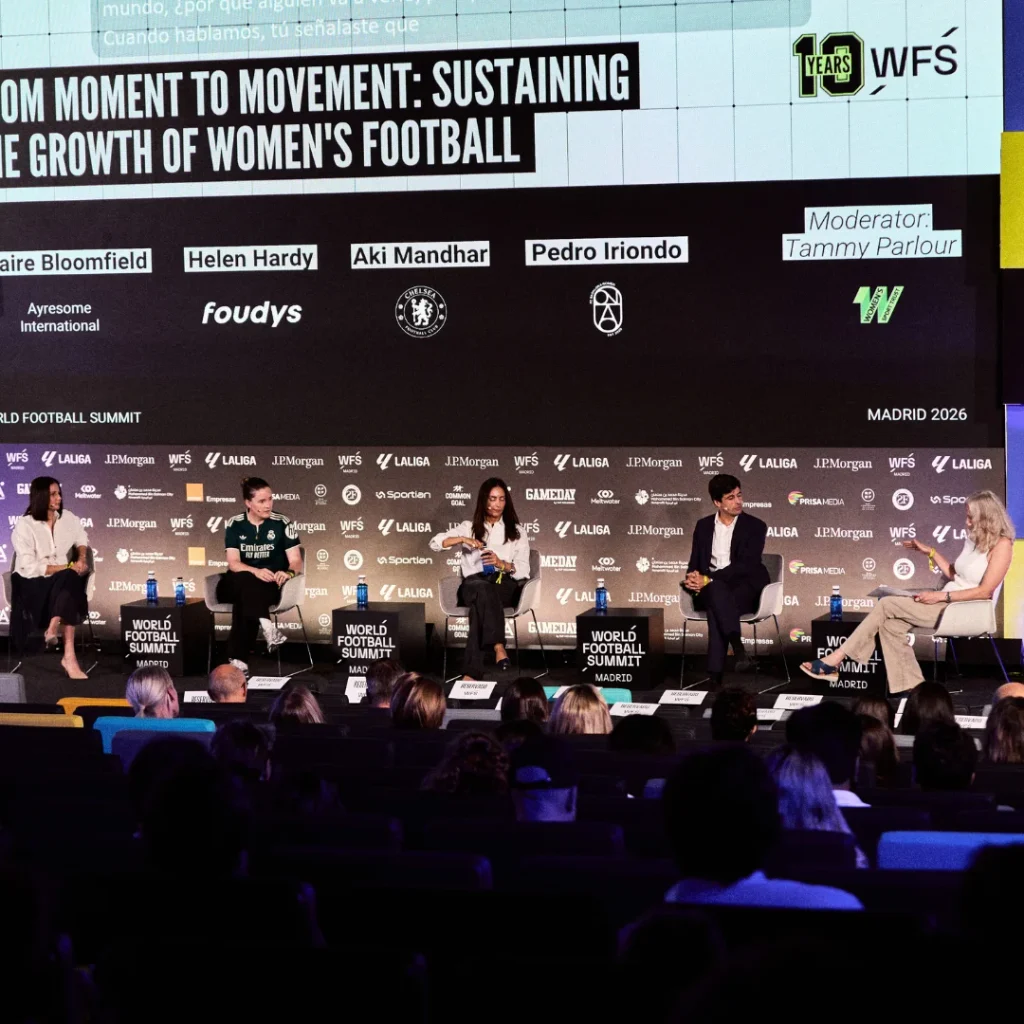
Claire Bloomfield, Managing Director of Ayresome International, and Pedro Iriondo, CEO of FC Badalona Women, reached the same conclusion from the regulatory side: fix the imbalance before it becomes a crisis, because the audience a World Cup or a Euros generates doesn’t convert into a durable domestic one on its own.

5. Player welfare is becoming a core club responsibility
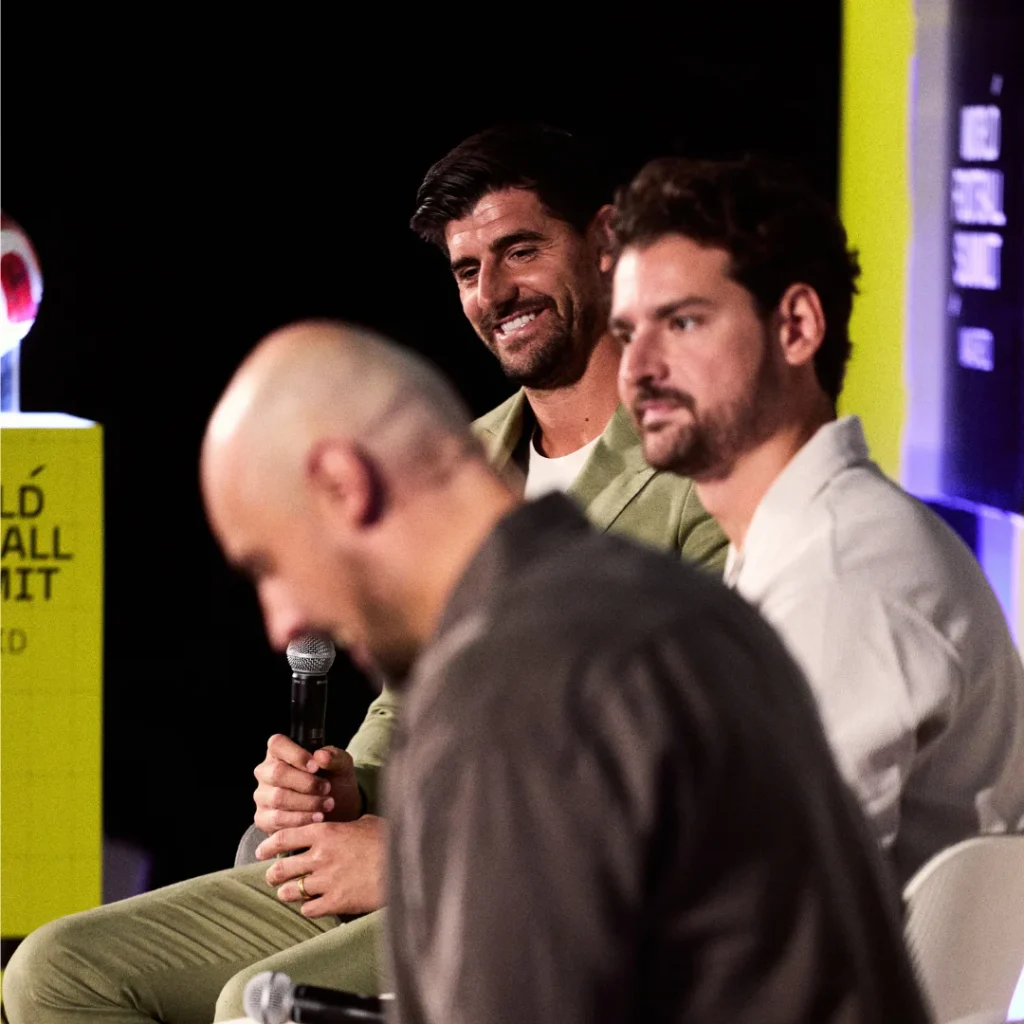
The instinct to treat a footballer’s life beyond the pitch — financial planning, mental health, life after retirement — as something managed privately by the player or their agent is losing ground, and multiple sessions approached the same shift from different angles. Chris Bird, Advisory Committee Member at 1XCare, drew a distinction other speakers echoed throughout the event: plenty of clubs now have a welfare department, far fewer have a welfare culture. Thibaut Courtois, Co-Founder of NXTPLAY, an investment platform built specifically for professional footballers, illustrated the financial end of that gap directly, explaining why he built it rather than simply lending his name to one — young players earn serious money fast, with little structure around what happens to it next.
Óscar Trejo, a recently retired footballer and former Rayo Vallecano captain, described what that gap feels like from inside the dressing room: “There were days we’d land back from a European away game at four or five in the morning on a Thursday, and the same Friday morning we had to train to prepare for a match on Saturday afternoon. Physically you’re drained, but mostly your head is somewhere else, wanting to rest.” João Paiva, Player Relation Manager at the Swiss Association Football Players: “There are studies in football showing that performance goes up, not down — contrary to what many clubs think.”
6. Sponsorship measurement is shifting from exposure to behavioural proof
The standard sponsorship pitch — reach, impressions, media value — is losing ground to a harder question from brands: did this partnership actually change what a fan did? Hector Romero, CEO of FXP, a sports data and insights company: “We are saying that we are using data. But the real thing is that we are not using that data as in other industries.” Marcel Cox, Commercial Director at Borussia Mönchengladbach, reframed what sponsorship is actually competing against in the first place: “Historically, the main currency we were all competing for was money. I think nowadays, society is moving towards a state where we are competing for time.” Jake Martens, Head of Commercial Planning at Brentford Football Club, located the source of the measurement problem: partnerships that were never given a defined objective at the outset are impossible to prove afterwards. Marga Castro, Amplify Director at You First-Gersh, added the shift from the agency side: brands haven’t lost interest, they’ve stopped accepting media metrics as sufficient proof on their own.

7. Social-impact work is being built as permanent, funded infrastructure
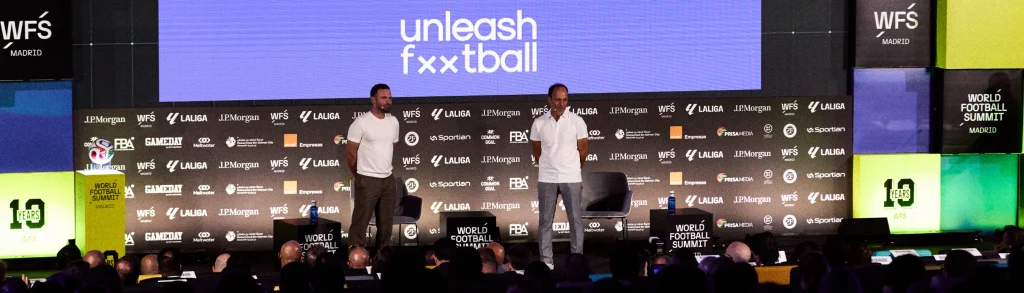
Football’s social-impact work is shifting from one-off campaigns to structures that clubs, players and foundations build and fund on an ongoing basis. Jürgen Griesbeck, Co-Founder of C_Lab, and former Spain and Manchester United midfielder Juan Mata used WFS Madrid to launch “Unleash Football,” a fan-and-player survey built to give supporters and athletes a structured, recurring channel to shape decisions about the game — something Griesbeck argued has never really existed: “What we want to create here is a place where all the positive energy can be steered towards, which I think currently doesn’t really have a place.” Matteo Salvatto, CEO & Founder of Asteroid, a communication-accessibility platform already deployed by clubs and stadiums in 75 countries, gave the scale of the audience that infrastructure now serves: 1.25 billion people live with some form of disability — one in seven humans — and more than 550 million of them specifically with communication disabilities most stadiums still aren’t designed for. Romina Calatayud, CEO of Girls United, a community and advocacy platform for women’s and girls’ football, pointed to what that kind of permanent structure makes possible: a schoolgirl once blocked from presenting on women’s football at her own school went through the platform’s programme and went on to address 300 women working in the Mexican football industry, winning a scholarship to a camp in London.
8. Opening media access is a deliberate growth strategy that redistributes power
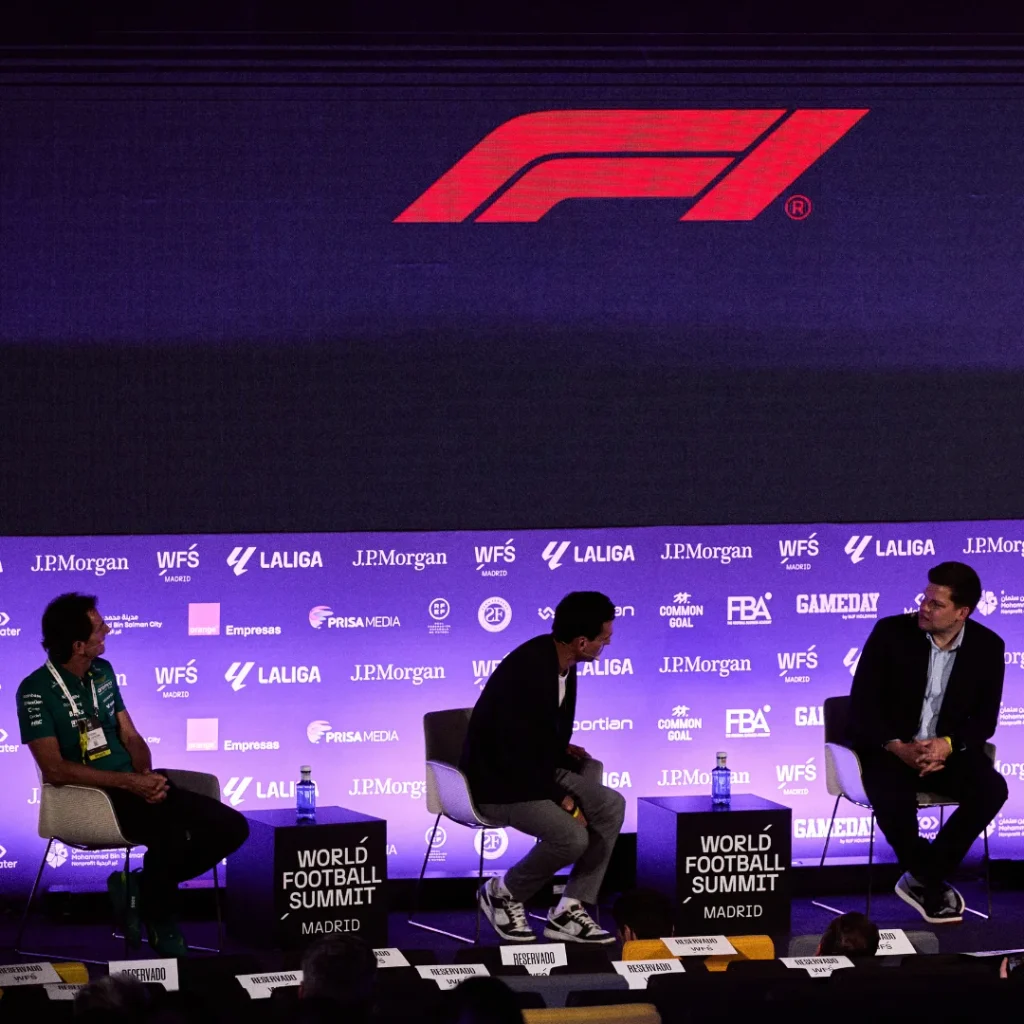
Formula 1 was WFS Madrid’s Official Guest Sport this year, and its transformation over the past decade offered the clearest case study in the room for what deliberate access can do. Liam Parker of Formula 1 credited Liberty Media’s 2017 decision to open up: “Why don’t we have a bigger audience? Why are more people of a younger age not engaging with us? And the answer was because we’re too closed.” Tom Rogers of Box to Box Films, the studio behind Drive to Survive, explained that the series’ breakthrough came from looking where the cameras weren’t already pointed — Mercedes and Ferrari sat out season one, which forced the show to build its story around less obvious figures instead.
Pedro de la Rosa, Aston Martin Aramco Formula 1’s ambassador and a driver through the sport’s more closed era, named what that openness redistributed: drivers who can now change teams without losing their fanbase, to the point that leading drivers have become effectively irreplaceable. Asked directly whether the model transfers to football, Parker’s answer was that it would need access to a whole league at once, not one club in isolation.
9. Markets outside Europe are building football on their own terms
Three federations from three different confederations made the same underlying case this year: growth outside Europe isn’t a story about catching up to Europe’s model, but about building distinct ones. Iñigo Riestra, Secretary General & Legal VP of the Mexican Football Federation and Liga MX, framed Mexico’s third World Cup as reinforcement of an already-global football nation: “For us, it’s one team, two nations.” Seiya Nobuta, Executive Director of J.League Europe, described thirty patient years since the league’s 1993 founding that took Japan from almost no players at Europe’s top level to over a hundred today, built on domestic foundations rather than chasing Europe’s calendar. Mai AlHelabi, CEO of AFC Asian Cup Saudi Arabia 2027, made the same point about sequencing from the hosting side: “Legacy is not something that happens after the tournament. For the Asian Cup, our legacy plan started back in 2020, when we won the bid.”
10. Creative direction is becoming a permanent function inside the club
Every club now has access to the same platforms, the same formats, the same tools, which leaves creativity as one of the only remaining points of differentiation — and most clubs still don’t have anyone whose job it is to own it. Alberto Fernández, Business Director of Baskonia Alavés Group, representing a club with more than a century of history, restructured the organisation around a single creative process: “Creativity for me is a tool that’s allowing us to be a different club.” Ángel Monzón, Founder & CEO of KAIS FC, is building a club from zero with creativity as the founding logic, already scaling to €450,000 raised through public transparency alone: “The strategy is what owns creativity” — not a single person with the power to approve or reject it. Bruno Bertolotti, Brand & Production Director at Late Checkout, supplied a concrete example of what that converts to in revenue: a centenary shirt for Celta de Vigo that sold 1,809 units in four hours, then a further 2,000 in twenty minutes. Pau Pía, CEO of V.T.C.C, backed it with the market-wide number: a 30% year-on-year rise in product built around cultural narrative rather than a generic template.


Reporting drawn from panels across both days and both stages of WFS Madrid 2026.