
Rio Ferdinand runs Rio Ferdinand Presents, a media company that generates revenue from both YouTube content and commercial brand partnerships. His journey from Manchester United defender to media entrepreneur offers insights into how athletes can build post-career infrastructure while still competing—and what unique assets former players can leverage that traditional rights holders cannot replicate.
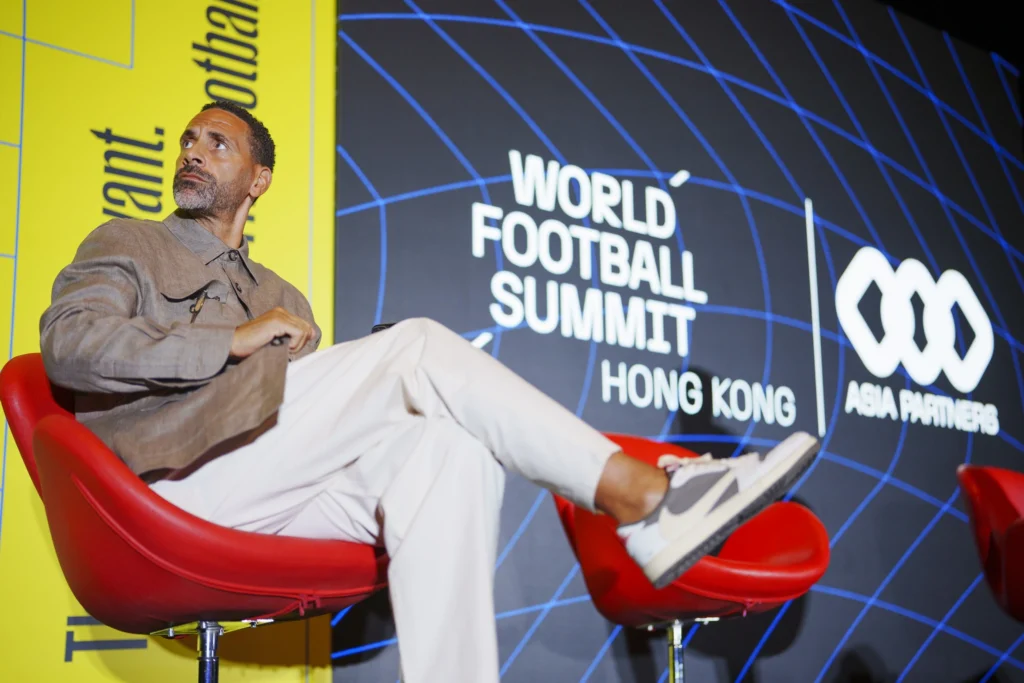
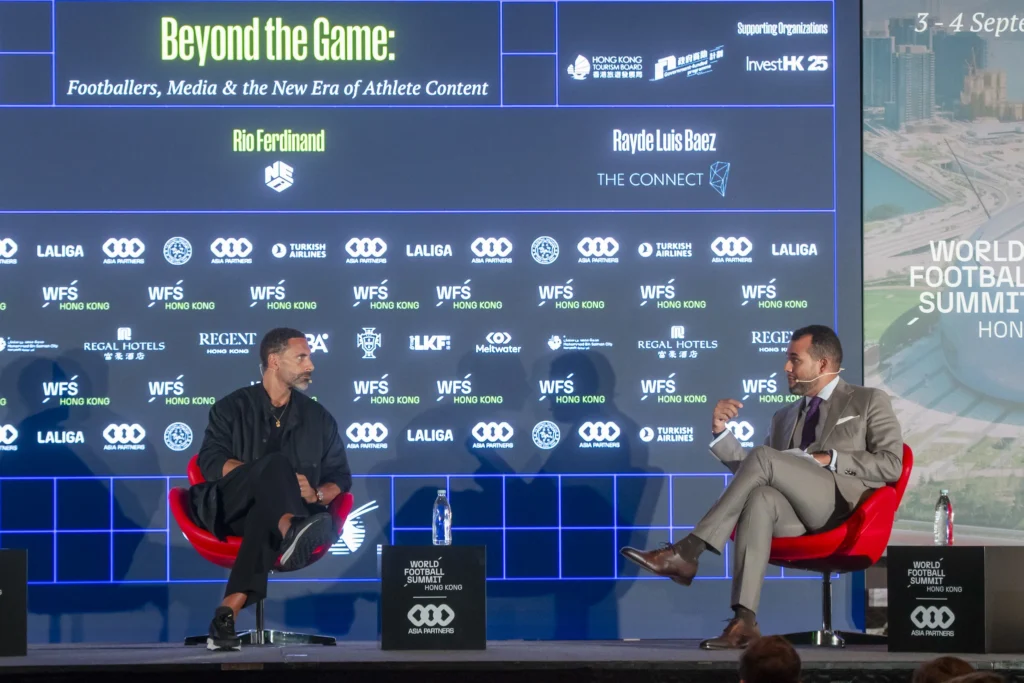
Speaking at World Football Summit Hong Kong, Ferdinand describes a structural gap in football media: “After a match, players go into the press zone and react to an emotional moment. You’re always protecting yourself, your team, your manager. The players you see in press zones isn’t really the guys I know.”
This gap between public persona and authentic personality has created Ferdinand’s business model: accessing conversations with current players that traditional broadcasters struggle to get.
Building During, Not After
Ferdinand’s first media venture came in 2009 while still playing at United: Five, a digital magazine. His first interview was 50 Cent. “I’ve played in huge games but I was sitting there thinking: shit, I’m interviewing 50 Cent. The next one’s LeBron James.”
Five won awards for being first to market, but Ferdinand’s real education was learning how media works from the inside. When Twitter emerged, he became the first UK footballer to adopt it strategically. “With social media I could still be visible, still have connectivity. If I have something to sell, I can do that.”
The timing was deliberate. “I made a conscious effort—when I got to a point where I could close my eyes and my week would run normally, that’s when I started to explore,” Ferdinand explains. The strategy: build visibility and infrastructure during peak playing years to maintain relevance after retirement.
But entrepreneurship among professional footballers was virtually non-existent at the time. When Ferdinand opened a restaurant in Manchester in 2007, the reaction from United’s management revealed the prevailing mindset. Ferguson and CEO David Gill called him into the office, concerned the venture would distract him from football. The assumption was clear: footballers should focus exclusively on the pitch. Business interests were seen as threats to performance, not preparation for life after.
Ferdinand’s response challenged that assumption: “Boss, if you’re going to give me a 20-year contract when I retire, I’ll stop the restaurant. If not, I’m sorry. Also… are we winning?” Ferguson couldn’t argue. United were winning and Ferdinand was performing. The restaurant stayed open for 15 years, and more importantly, the principle was established: as long as sporting performance didn’t suffer, entrepreneurial exploration could continue.
The Business Model: Trust as Commercial Asset
Rio Ferdinand Presents operates on two revenue streams, both dependent on the same competitive advantage: trust-based access.
B2C: Long-form interviews (Michael Owen, Cristiano Ronaldo, David Beckham, Wayne Rooney forthcoming) distributed via YouTube. “We live outside the 90 minutes,” Ferdinand explains. “A lot of the rights holders live inside the 90 minutes—which is great—but I’m equally interested in what happens outside.”
B2B: Brands paying for authentic player access for advertising campaigns. “Commercial companies come to us to unlock players for campaigns because they know the relationship and trust means the conversation will be more authentic.”
The competitive advantage isn’t follower count or production quality—it’s access. “There’s a trust element because I played the game. I’m not there to trip them up or get a headline. I’m there to make them feel comfortable and be the real guy I know in the changing room.”
Authenticity as Commercial Strategy
For Ferdinand, authenticity drives the business model. “Authenticity is the king and that’s longevity. At some point, bullshit will be seen.”
He points to Lamine Yamal as evidence of generational shift: “This kid is authentic, he’s him. The old generation sometimes doesn’t like how he is, but all his generation understands it. Brands are starting to understand—it’s appreciating culture rather than trying to be this perfect human that no one is.”
Symbiosis With Traditional Media
Ferdinand rejects framing this as new media versus traditional media. “Both can live together and complement one another. Live football needs the behind-the-scenes access. The problem that old media has is trust.”
Ferdinand’s business doesn’t compete with broadcasters—it provides access they need but can’t produce themselves. “I’ve stepped away from the normal studio now and it feels like my shackles are off,” he says. “I’m travelling around the world, going to these guys in their houses, talking real football.”
Lessons for Athletes
Ferdinand’s journey offers specific insights for post-career planning:
Start infrastructure during playing years. Ferdinand launched Five in 2009, four years before retirement. By the time he stopped playing, he had distribution, relationships, and market understanding.
Identify your unique asset. Ferdinand’s value isn’t presenting skills—it’s trust-based access to players that traditional media can’t replicate.
Build dual revenue streams. Content alone rarely generates sufficient income. Ferdinand’s B2B model—brands paying for authentic access—creates higher-margin revenue alongside advertising.
Understand ecosystem positioning. Ferdinand’s business doesn’t replace broadcasters; it complements them by providing something they need but can’t produce.