
More than half of the players who join or leave LaLiga clubs move within Spain, yet most of the money that changes hands in the league’s transfer market comes from, or goes to, clubs abroad.
Between 2016-17 and 2025-26, deals with foreign clubs accounted for 71.12 per cent of LaLiga’s spend on signings and 75.51 per cent of its transfer income, according to a report by BeSoccer Pro and World Football Summit that covers 5,201 player movements up to the close of the 2026 summer window.
Almost all of that spend goes to European clubs, the origin of 92.03 per cent of LaLiga’s signings over the decade, and within that flow each market plays its own role for the league. English clubs have become the main buyers of LaLiga players, while in Portugal, Germany and Brazil the league’s clubs buy considerably more than they sell.
England, the main buyer
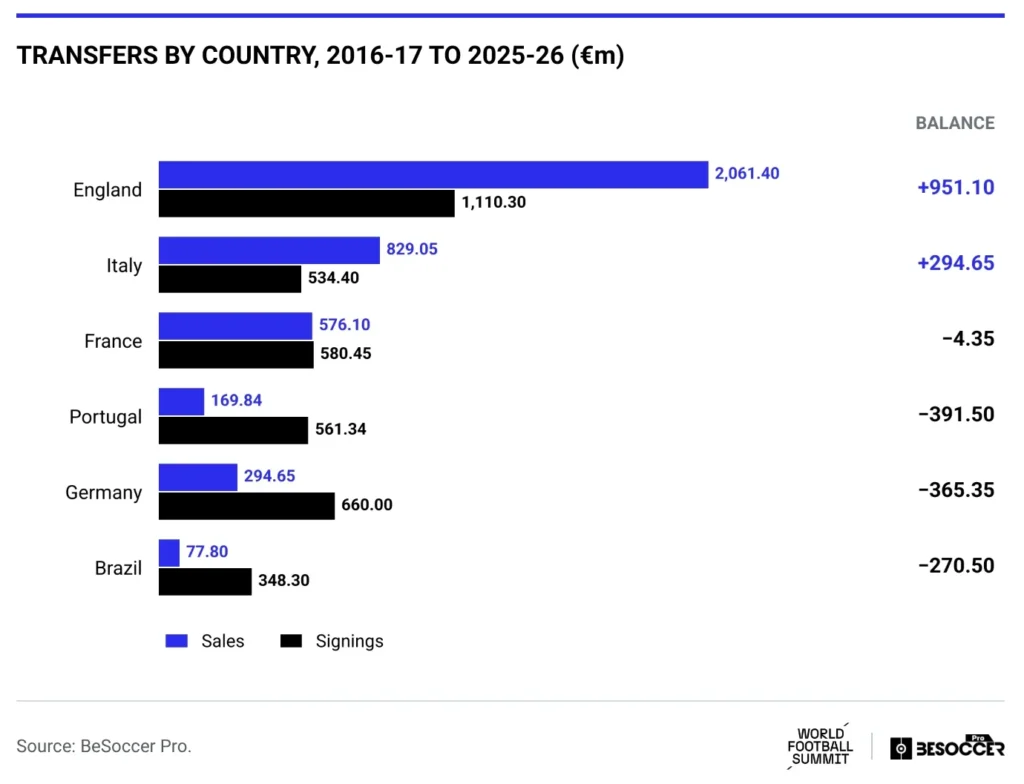
English clubs contributed €2,143.45m to LaLiga’s transfer income between 2016-17 and 2025-26, almost a third of the total, even though they were the destination of only 12.06 per cent of the league’s outgoing transfers. The explanation lies in the value of each deal, since a transfer to an English club brought in an average of €24.25m, four times the €5.72m of a transfer between two Spanish clubs. Behind that difference sits the revenue gap between the two competitions: according to Deloitte, Premier League clubs generated €8,090m in 2024-25, almost twice the €4,100m of LaLiga clubs.
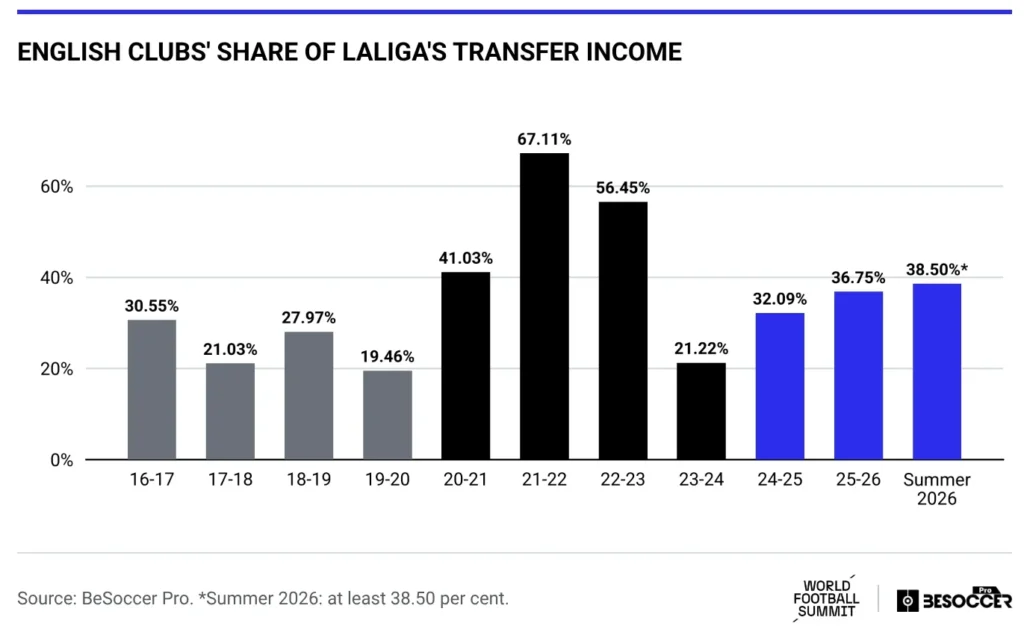
The weight of English buyers grew sharply during the pandemic, when they provided two of every three euros LaLiga clubs received in transfer income in 2021-22, and after falling back in 2023-24 their share has risen in each of the following seasons, to at least 38.50 per cent in the 2026 summer window. Fulham, which paid Real Madrid €40m for Gonzalo García, and Liverpool, which paid CA Osasuna the same amount for Víctor Muñoz, led the six English clubs that spent €180.40m on LaLiga players that summer.
The flow also runs the other way, at lower prices. LaLiga clubs signed 77 players from English clubs for €1,110.30m, with Philippe Coutinho’s move from Liverpool to FC Barcelona (€160m) and Eden Hazard’s from Chelsea to Real Madrid (€100m) as the largest deals. With an average fee of €14.42m for those signings, well below that of the 85 players sold to English clubs, LaLiga’s balance with England stands at €951.10m in its favour.
Where LaLiga buys
In Portugal, Germany and Brazil the balance tips the other way, because LaLiga clubs have spent considerably more there on signings than they have earned from sales. Germany accounts for the largest outlay of the three, €660m on 38 transfers, including those of Ousmane Dembélé and Jude Bellingham from Borussia Dortmund to FC Barcelona and Real Madrid, and those of Dani Olmo from RB Leipzig and Robert Lewandowski from Bayern Munich, both to FC Barcelona, while sales to German clubs generated €294.65m.
Portugal follows with €561.34m spent on 47 transfers, among them João Félix’s move from Benfica to Atlético de Madrid and those of Éder Militão from FC Porto and Álvaro Carreras from Benfica to Real Madrid, against €169.84m earned from 24 sales. In Brazil, where Real Madrid signed Vinícius Júnior from Flamengo, Rodrygo Goes from Santos and Endrick Felipe from Palmeiras, and FC Barcelona signed Vitor Roque from Athletico Paranaense, LaLiga clubs spent €348.30m on 21 transfers and earned €77.80m from 11.
Italy, France and Asia
Italy, by contrast, is the market with the most favourable balance for LaLiga after England. The 53 transfers in each direction leave €294.65m in the league’s favour, with Cristiano Ronaldo’s move from Real Madrid to Juventus in 2018, for €117m, as the largest deal. With France the balance is practically even, at €4.35m against LaLiga, although a single operation, the €222m Paris Saint-Germain paid FC Barcelona for Neymar Jr. in 2017, accounts for 38.53 per cent of everything LaLiga clubs have received from French clubs.
Asian clubs, mainly in China and Saudi Arabia, have worked above all as a destination for LaLiga players. Over the period, 102 players left for Asia and generated €405.79m, while only 31 arrived from Asian clubs, for €98.70m.
The domestic circuit
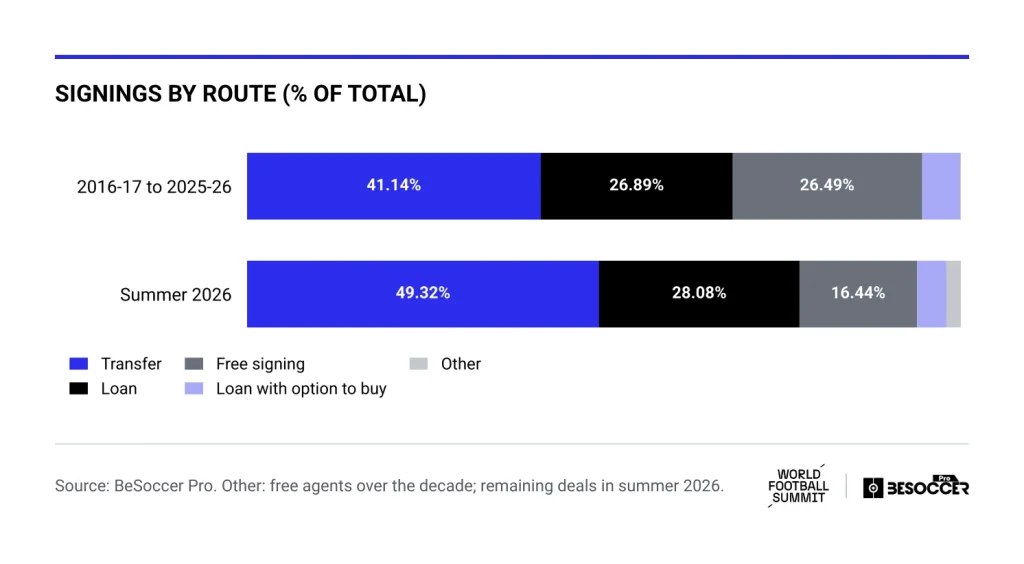
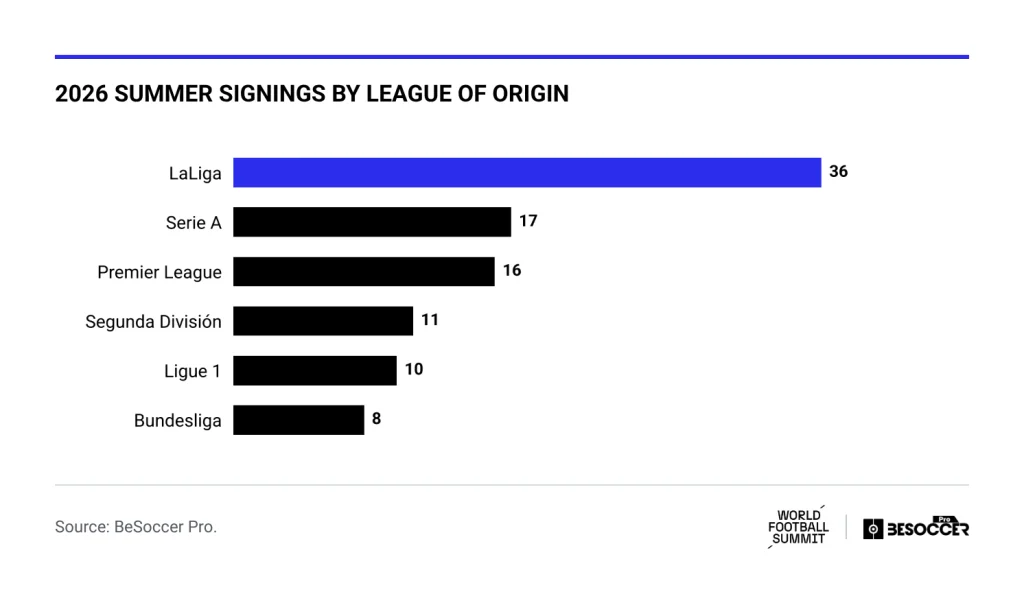
Between Spanish clubs, the market runs mainly on loans. Of the 1,600 players who left LaLiga clubs for other Spanish clubs over the decade, half went on loan and 437 left without a transfer fee, while only 289 moves involved a transfer. The 2026 summer window kept the same pattern, with LaLiga itself as the main competition of origin for the league’s signings and Segunda División as the main destination of its departures, so that the domestic market gives continuity to player development and squad building while most of the transfer income comes from abroad.
The full report, “¿Cómo ficha la Liga Española? Radiografía de una década”, by BeSoccer Pro and World Football Summit, is available here only in Spanish: https://forms.worldfootballsummit.com/t/r9SqahJ8Sius