
104 matches. 48 teams. Three countries. And an audience that expects content 24/7 across every platform imaginable.
The 2026 FIFA World Cup will be the largest in history, and for TelevisaUnivision and its sports division TUDN, it represents a broadcasting challenge with no precedent. All 104 matches will be available across the company’s platforms—ViX will stream every single game—and the tournament unfolds in Mexico, where TUDN operates from a position no other broadcaster can claim: at home, days before the opening match kicks off at Estadio Azteca.
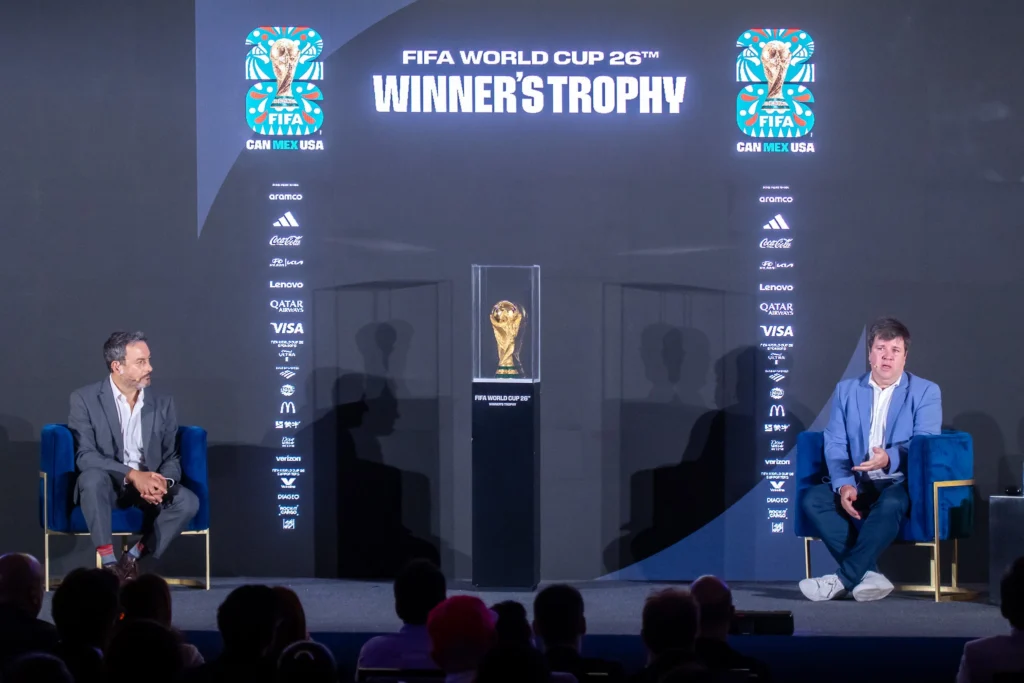
At WFS Mexico 2025, Olek Loewenstein, Global President of Sports at TelevisaUnivision, outlined how TUDN is approaching the challenge. Loewenstein will return to the WFS stage at WFS Mexico 2026 (June 3-4, days before the opening match at Estadio Azteca). His comments reveal the strategic pillars behind the company’s World Cup content strategy.

Multiplatform means multiplatform
“Content has to be generated 24/7 and multiplatform,” Loewenstein said. “It’s a word that’s been used a lot in the media world for many years. But this is the first time where, being in the country, people will want to know what’s happening, where, at every moment.”
TUDN’s strategy isn’t about repurposing the same content across different platforms. It’s about generating content specifically designed for each one—linear TV, streaming (ViX), digital, social—and doing it simultaneously, in real time, throughout the tournament.
Serve every type of audience
A World Cup is consumed differently than a regular Liga MX match. Entire families sit together—from the grandmother who knows every tactical formation to the uncle who has never watched football. TUDN’s content has to work for both.
“You have to be able to educate those who don’t necessarily understand what’s happening,” Loewenstein explained, “while also giving every detail to that football-obsessed grandmother who wants to know the lineups, who’s injured, what happened in the press conference.”
The content strategy has to balance accessibility with depth, entertainment with information, all without alienating either end of the spectrum.
Go beyond the 90 minutes
People will finish watching one match and immediately want the next one. But between matches, they’ll want stories. What do the players eat? How do they travel between cities? How are teams managing the distances and time zones across three countries?
“The 90 minutes are something we can sit down, watch, laugh, cry, criticize,” Loewenstein said. “But the reality is it doesn’t end there. People are going to want the next match and they’re going to want to understand what happened in between.”
TUDN’s content operation is built around this: continuous storytelling that extends far beyond match coverage.
Mexico as a window to the world
Working alongside FIFA, TUDN will be generating content for global broadcasts—stories that showcase Mexico’s cities, culture and gastronomy to audiences worldwide. This isn’t just about football. It’s about using the World Cup as a platform to tell Mexico’s story.
“It’s about showing the magic cities, the food, the culture—opening the doors of the country to the world through images, video, audio,” Loewenstein said.
Build a legacy
For the 600 people at TelevisaUnivision who will work on the tournament, the World Cup represents a unique learning opportunity. Many will be embedded with FIFA’s global content team, working on productions that will be seen by billions.
The experience they gain—the knowledge, the contacts, the expertise—will reshape the Mexican sports media industry long after the final is over.
The World Cup is coming. The content challenge is already here.