
Club valuations across Europe have grown faster than revenue, and access to the group capturing that growth has been almost closed for a decade.
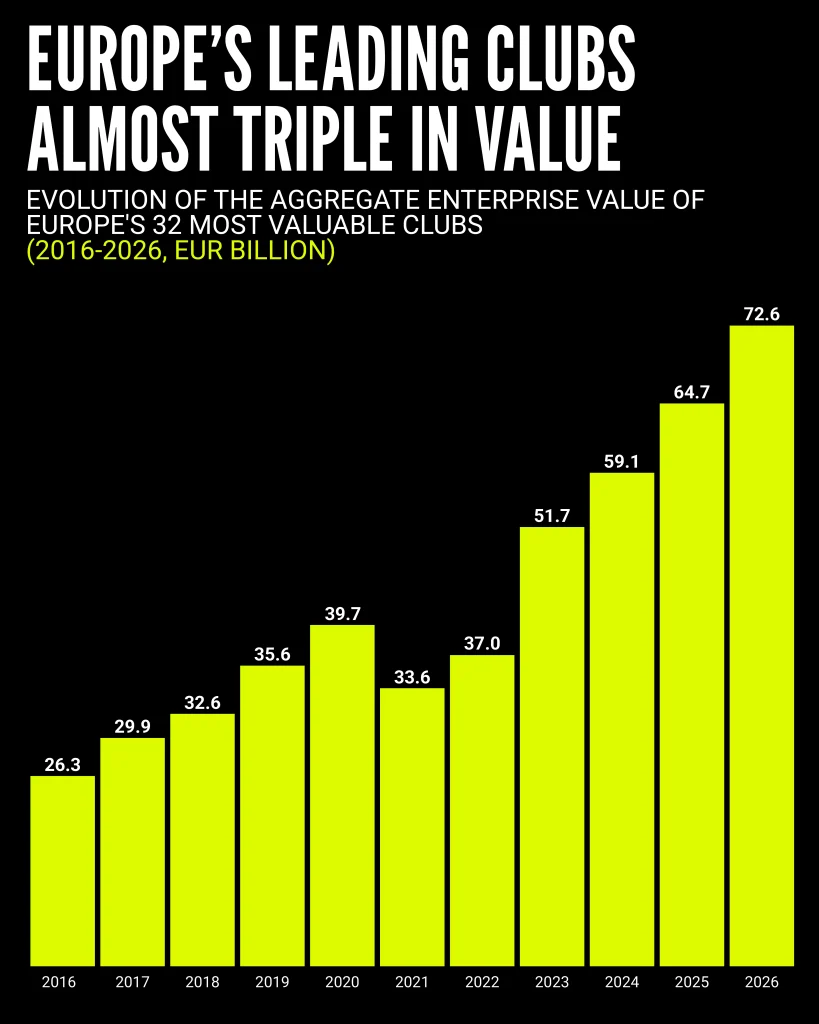
The combined Enterprise Value of Europe’s 32 most valuable clubs rose from €26.3bn in 2016 to a record €72.6bn in 2026, according to The Evolution of Club Revenues in European Football, the report by Football Benchmark and World Football Summit, which attributes the growth to higher revenues and squad values as well as to growing investor confidence in football as an asset class. The only interruption was in 2021, when the pandemic pulled value down to €33.6bn from €39.7bn the year before. Value did not return to its pre-decline level until 2023, when it reached €51.7bn, and has set a new high every year since.
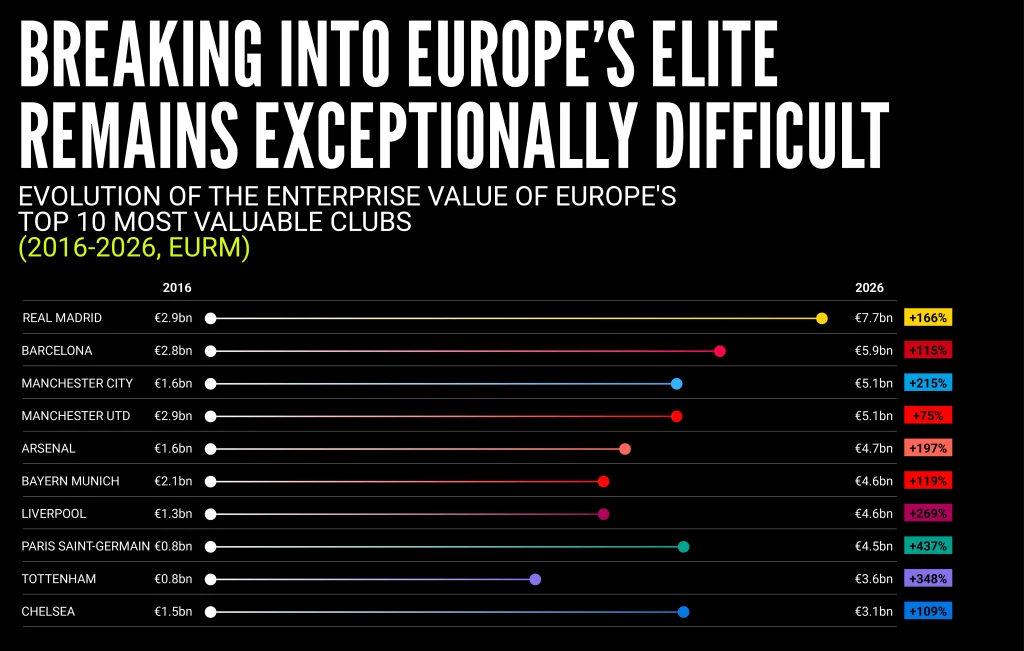
Only 11 clubs have featured in the Enterprise Value top 10 between 2016 and 2026, and Juventus is the only one outside the current group of ten. Keeping their place has not meant growing at the same pace: ten-year value growth within the group ranges from 75% (Manchester United) to 437% (PSG).
Real Madrid leads that group as Europe’s most valuable club, the first European club to surpass an Enterprise Value of €7.7bn, as at 1 January 2026. It is also the highest-revenue club, the first to pass €1bn in annual revenue, in 2023/24, with Barcelona following in 2025/26. Yet Real Madrid’s own ten-year value growth, 166%, sits roughly in the middle of the top 10’s range, well behind PSG’s 437% or Tottenham’s 348%.
The Evolution of Club Revenues in European Football: How growth has reshaped the economics of the game, the report by Football Benchmark and World Football Summit, covers this alongside the rest of the picture: how European club revenues have grown 146% in fifteen years to over €30bn, how that growth has concentrated in the Premier League and the biggest clubs, and how commercial income has overtaken broadcasting as the top clubs’ main source of revenue.
Download the full report. HERE